Skip to content

Music rights, splits and clearances, ready before the release is.

Each release keeps its tracks, contributors, splits, codes and clearances together, beside the agreements that set them. It keeps score of what is still missing before the release goes out, and exports as a dossier, a workbook or a full package for whoever has to check it.

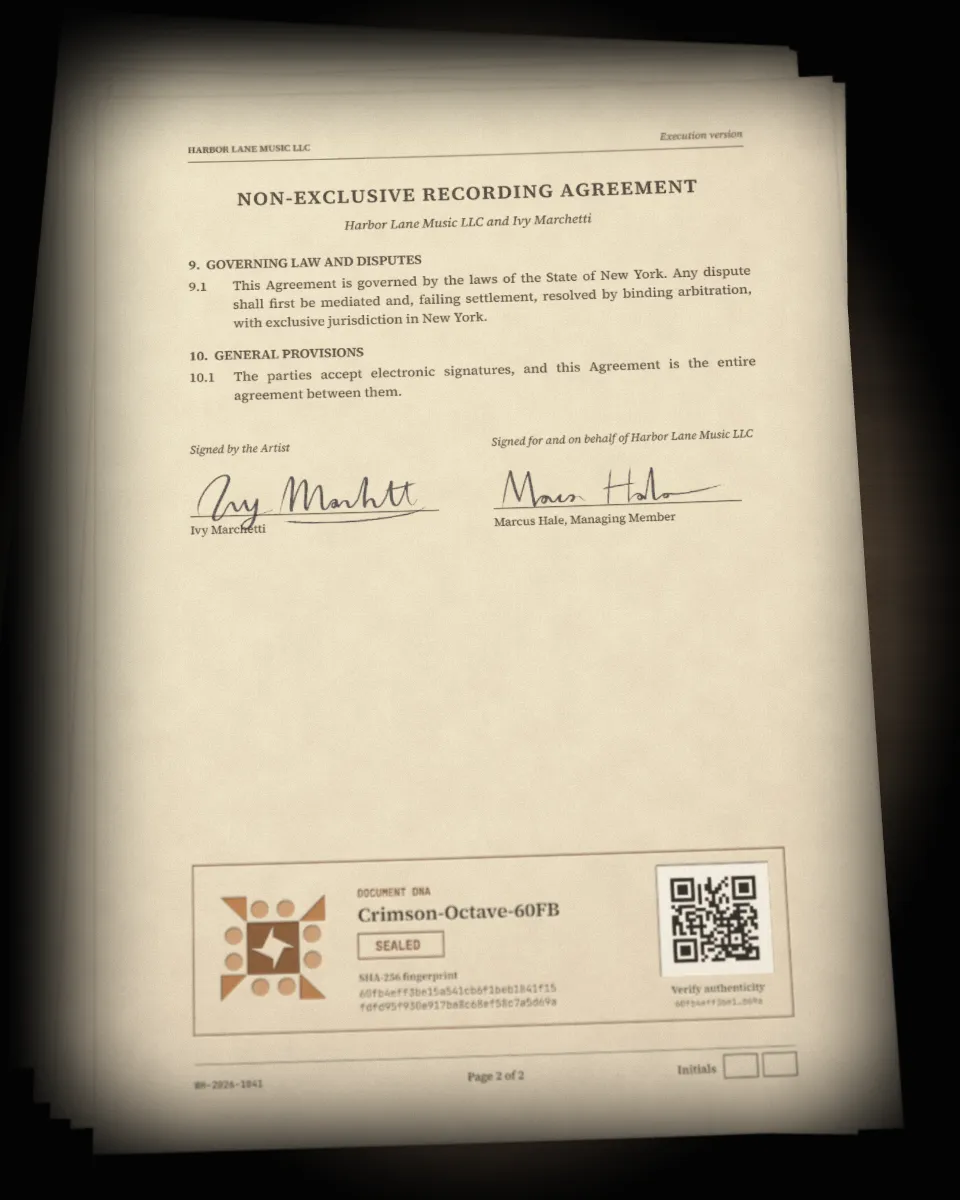
Every signed agreement, filed together on one pile.
01

Who owns what, track by track.

Every track carries its ISRC and ISWC, and every contributor their role, PRO, IPI/CAE, publisher, master share, composition share and producer points. A total over a hundred per cent will not save. A total under it saves, and shows as a blocking issue until it adds up.

  • Master and composition shares, side by side
  • PRO, IPI/CAE and publisher for each contributor
  • UPC, catalogue number and the ℗ and © lines for each release
02

Split sheets, agreed and signed.

A split sheet started from a release seats its contributors for you. It cannot be sealed until the shares reach a hundred, and once it is, the agreed shares are written back to the release. Making a sheet is free; sending it for signature uses credits.

  • Six kinds of split sheet
  • Up to ten contributors and twelve works on one sheet
  • Agreed shares written back to the release
03

Readiness is a score, not a gate.

Each release scores out of a hundred across six stages: identity, tracks, splits, clearances, registrations and term. The clearances it looks for are a split sheet, a producer agreement, a featured artist agreement, sample clearance and an artwork licence, and a missing sample clearance counts as blocking. Nothing stops you releasing; the score tells you what you would be releasing without.

  • Six stages and one score
  • Blocking issues and warnings, listed by name
  • Release days and term ends on the calendar
04

Registrations tracked, and a record others can inspect.

For the United States, twelve registration steps each come with the fee, the usual processing time and a link to the official site, and you mark each one as it moves. The release exports as a dossier PDF, an Excel workbook of tracks and splits or a full package, and a read-only link can carry a password and be revoked.

  • Twelve US registration steps, with fees and timings
  • Dossier PDF, Excel workbook and full package
  • Read-only share links, with a password if you want one

Worked example

Glasshouse, IVY M's album on Lanternfield Records Limited, is filed with UPC 5056321804174 and its splits: Ivy Marchetti 50%, Tomás Varga 35% and Dele Okafor 15%, a hundred between them. Its 4 files sit beside it, from the split sheet to the label copy, and with the clearances filed the release scores 100.

Watch this deal on the home page

What it does not do

  • It does not register anything for you. It tracks where each registration stands and links to where it is filed.
  • It does not pay anyone. Splits are recorded and checked, never paid out.
  • It checks the arithmetic, not the fairness. A split that adds up is not a split anyone agreed is fair.

Questions

What music rights information can I track?

Releases, tracks, contributors and their roles, master and composition shares, producer points, PRO and IPI/CAE, ISRC, ISWC and UPC codes, clearances, registrations and the documents behind them.

Does WALDHORN.AI register copyrights for me?

No. It lists each registration step with its fee, its usual timing and a link to the official site, and records the status you set. It never says a work is registered unless you have recorded it.

What happens when the splits do not add up?

A total over a hundred per cent will not save. A total under it saves, and stays a blocking issue in the release's readiness until it reaches a hundred.

Can I export a release's rights record?

Yes: as a dossier PDF, an Excel workbook of tracks and splits, or a full package. A read-only share link can carry a password and be revoked at any time.

Start with the contract you are about to sign.